A STORY BETWEEN FLOWERS AND FIGURES
A garden holding a scene
Trunk-retablo 70041 invites a second look: first at the decorated chest, then at the figurative world within it. What happens when a familiar container becomes a stage for storytelling?
Flowers may be an invitation
Vegetal decoration appears across examples of the Ayacucho tradition. Peru’s Ministry of Culture describes flower-painted doors on certain San Marcos chests. For record 70041, that resemblance raises a compelling question: might ornament prepare the eye for the figures inside?
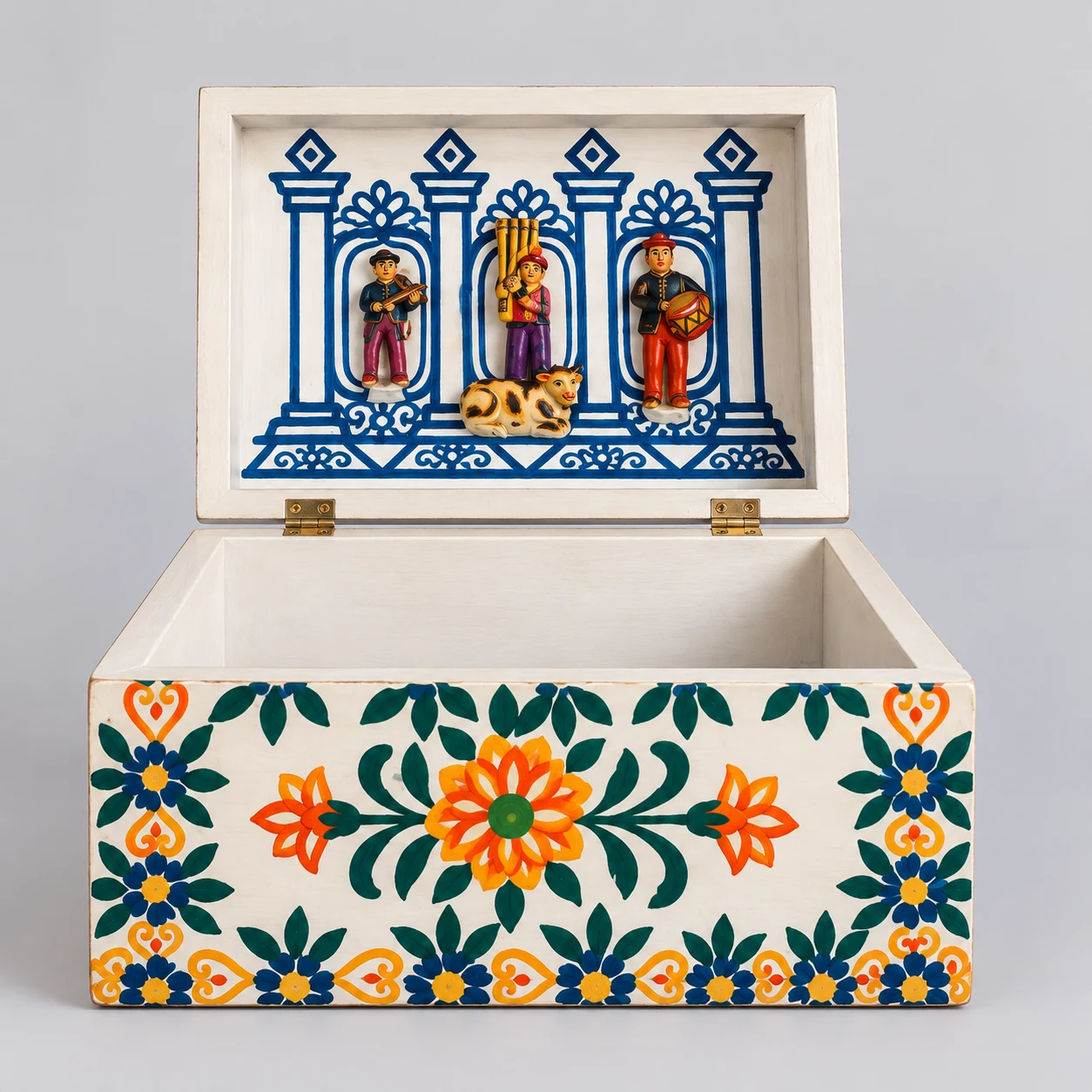
We need not invent a fixed meaning for each flower to admire its compositional role. It may equally reflect an individual workshop’s taste. That possibility makes the piece richer: it resonates with a regional vocabulary without proving its maker’s intention.
Explore the historical sources: Ministerio de Cultura / Museo Nacional de la Cultura Peruana · Ministerio de Cultura del Perú
The intimacy of a chest, the imagination of a stage
The museum records dimensions of 21 × 32 × 22 centimetres, bringing this work down to an intimate scale. The figurative lid and chest body suggest a fascinating tension between holding something close and displaying it to another person.
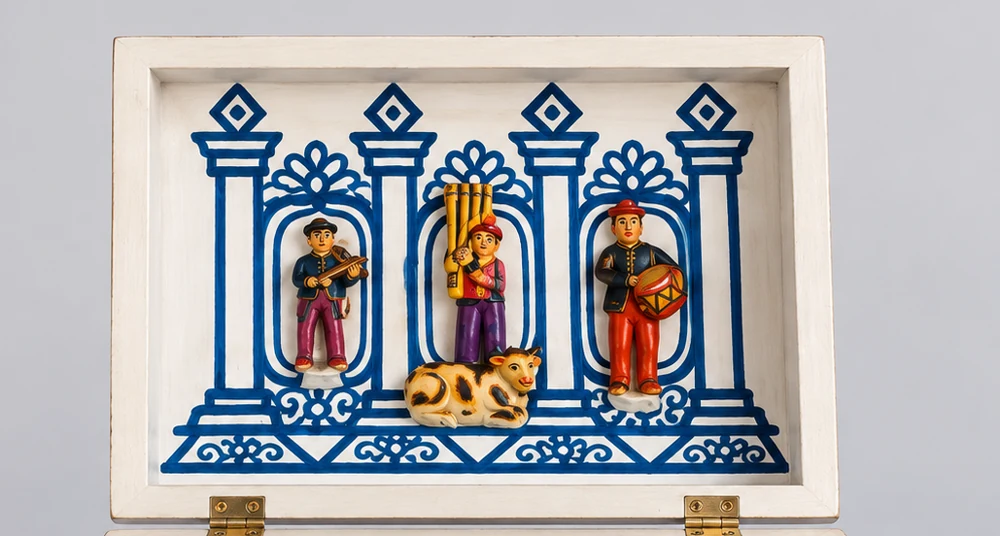
We do not know whether the historical chest was actually used for storage. Still, its form offers a thought-provoking way to consider a story protected until it is revealed. A future artisan commission can explore that relationship through carefully agreed choices of structure, finish and scale.
Explore the historical sources: Ministerio de Cultura / Museo Nacional de la Cultura Peruana · Instituto Nacional de Cultura / Museo Nacional de la Cultura Peruana
THE ATELIER COLLECTION
From the story to your own commission
Discover designs inspired by the heritage of Ayacucho. Each proposal opens the door to a new handcrafted piece made especially for your collection.
ATELIER DESIGN Historic reference · 70041
Trunk retablo · flowers and figures
Artisan commission · tailored quotation
Imagine this piece in your collectionAtelier AllpaCraft designs inspired by historical references. Explore the museum records in the sources and commission a new artisan creation.
ATELIER DESIGNS · COMMISSIONED WORK
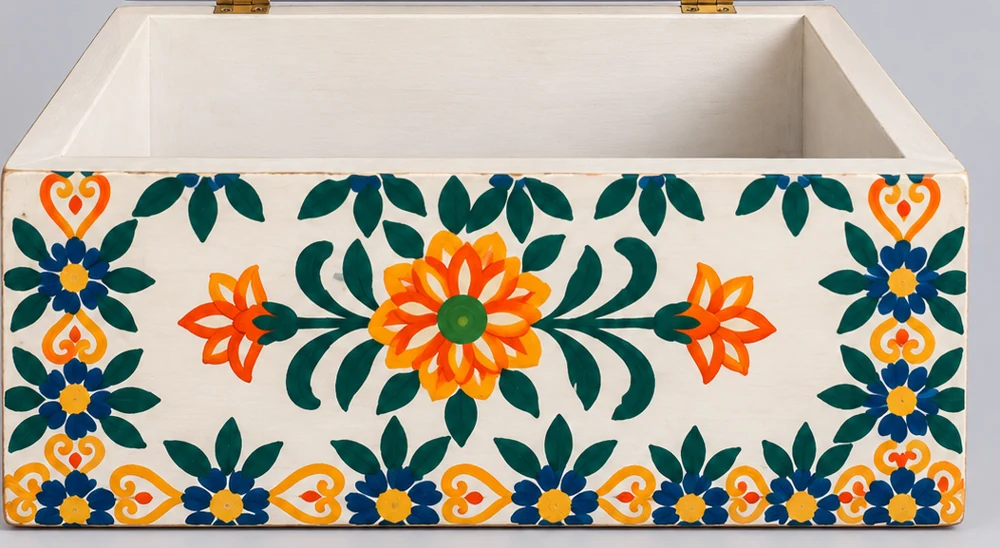
A closer look at this Atelier design, conceived as inspiration for a new handcrafted commission.
Explore the research behind the story Historical records, interpretations, methods and unanswered questions
VISUAL EVIDENCE REVIEW
What reference images show — and what remains uncertain
Compared with one archival museum overview, not a physical examination. A reference image does not document completed handmade work; iconography and construction require specialist review.
- Museum overview
- The documentary view shows a lid with small figures above a lower body painted with floral motifs.
- Broad structure retained
- The reference image retains the overall relationship between floral lower body and figurative upright lid.
- Differences / uncertainty
- The reference image sharpens flower and figure outlines and raises colour intensity; the single image does not verify each character.
Decisions requiring a specialist master
- Inventory legible lid figures from higher-resolution evidence and mark unclear ones as unknown.
- Validate lid-body geometry, actual depth, hinges, fastening and figure supports without asserting undocumented reverse views.
- Specify chosen timber, modeling compounds, glues and pigments for the new commission, not as authenticated original materials.
Measured colour saturation differs between source images, but cannot establish the original paint colour or the accuracy of a future handmade recreation.
View historical photographs in the official Ministry collection record ↗ · Museum photograph reuse rights remain unverified.
01 / RESEARCH QUESTION
The central question
What does the record actually establish, and what must a maker decide when recreating the object?
Interpretive thesis
The floral front and figurative lid supply useful visual evidence, but do not reveal undocumented methods, maker or the identity of every miniature.
02 / THE RESEARCH
How we traced this story
- Consulted National Museum of Peruvian Culture collection records, historical documents and specialist publications. Each object’s recorded characteristics were kept distinct from the interpretations explored by AllpaCraft.
- Contextual museum, heritage and scholarly literature explains forms and historical uses; it does not automatically attribute an individual object to a named maker.
- Separates documented facts about the museum object, what can be seen in the photograph, and proposals requiring validation by a commissioned Atelier master.
03 / CLUES FROM THE SOURCES
What the historical sources reveal
These clues connect documented history with possible meanings. The original records are linked so you can explore the story yourself.
A securely identified record
- What history tells us
- The museum records an ethnographic wooden trunk retablo dated broadly to the twentieth century.
- A possible meaning
- Using its exact collection identifiers is more reliable than attributing it to a famous workshop by resemblance.
- A question worth exploring
- No precise year or creator is supplied.
Discover the sources: Ministerio de Cultura / Museo Nacional de la Cultura Peruana
Floral case and figurative lid
- What history tells us
- A frontal photograph shows floral decoration on the chest and small figures within its open lid.
- A possible meaning
- These separate visual planes define its distinctive design.
- A question worth exploring
- A single 600-pixel image cannot establish the identity or manufacture of every figure.
Discover the sources: Ministerio de Cultura / Museo Nacional de la Cultura Peruana
Typological context, not proof of provenance
- What history tells us
- The museum's 2008 publication describes related devotional chests.
- A possible meaning
- The studied object belongs within that broader visual discussion.
- A question worth exploring
- It must not be equated with the specific López Antay example reproduced in the book.
Discover the sources: Instituto Nacional de Cultura / Museo Nacional de la Cultura Peruana
DOCUMENTARY SOURCE TRIANGULATION
Stories and clues from the archives
Museum records preserve names, dimensions and dates; research opens further ways to understand the figures and stories. Each clue is linked to a source, with possible interpretations clearly identified.
FROM THE ARCHIVES
Ministry record 70041 identifies a wooden trunk-retablo under national registration 0000089733 and MNCP-000000009543, with recorded dimensions of 21 × 32 × 22 cm.
Explore the interpretation and its open questions
What we can discover so far
These figures and the wood designation concern the archived original, not each component's composition or the specifications of a future commissioned piece.
- Ministerio de Cultura / Museo Nacional de la Cultura Peruana — individual object record
ONE POSSIBLE READING
The chest's floral ornament may connect with a regional devotional vocabulary: the 2019 heritage declaration describes roses and flowers on San Marcos chest doors, without assigning the same meaning to every object.
Explore the interpretation and its open questions
What we can discover so far
This combines a general image observation with writings on related types; the 2019 declaration does not discuss inventory item 70041 or authenticate its specific iconography.
Another way to read the scene
The decoration may reflect workshop conventions or purely ornamental preferences, without a demonstrable ritual function for this particular chest.
A question for further research
Compare the flowers and figures with documented workshop pieces and higher-detail original images, keeping illegible motifs unassigned.
- Ministerio de Cultura / Museo Nacional de la Cultura Peruana — individual object record
- Ministerio de Cultura del Perú — typological context
- Instituto Nacional de Cultura / Museo Nacional de la Cultura Peruana — typological context
ONE POSSIBLE READING
A closed lower chest and an upper figurative scene invite a hypothesis of combined storage and narrative display within a historic design.
Explore the interpretation and its open questions
What we can discover so far
No physical examination, use history, wear pattern or recorded original contents are available; chest-like shape alone does not establish real storage use.
Another way to read the scene
It may have been conceived as a display piece with a lower structural compartment rather than as a functional container.
A question for further research
Seek images of the inner compartment, acquisition records and documented traces of use before assigning any practical function.
- Ministerio de Cultura / Museo Nacional de la Cultura Peruana — individual object record
- Instituto Nacional de Cultura / Museo Nacional de la Cultura Peruana — typological context
- Universidad Nacional Mayor de San Marcos — documentary comparison
REGIONAL ICONOGRAPHY AND WORKSHOP HISTORY
The craft, its artists and the stories they shared
Other collections and research help us trace how Ayacucho artisans transformed familiar forms into new narratives. We compare ideas and techniques while respecting the individual history of each museum object.
ICONOGRAPHIC COMPARISON
Flowers and doors: formal resemblance, not a proven meaning
The Ministry describes floral doors on San Marcos chests; a different piece in the AECID collection, titled Nativity (inv. 585 CA), also has painted vegetal ornament and hinged doors. These are typological comparisons, not object 70041.
- Research hypothesis
- Ornament on 70041 may belong to a regional repertoire shared by devotional boxes, potentially making the craft tradition visually recognizable across different uses.
- Viable alternative
- The flowers may be workshop ornament or a response to buyers' preferences rather than symbols with a specific narrative function.
- What still invites research
- Neither the Ministry's 2019 announcement nor the description of a different AECID object authenticates the motifs, pigments or maker of MNCP-000000009543. Any object-specific meaning remains unproven.
References: Ministerio de Cultura / Museo Nacional de la Cultura Peruana · Ministerio de Cultura del Perú · Agencia Española de Cooperación Internacional para el Desarrollo
WORKSHOP HISTORY
From ritual box to circulating artistic retablo
The 2019 heritage declaration and Ortiz Ortigas's PUCP thesis (2024) discuss changing subjects and circuits of circulation, particularly the development of Joaquín López Antay's work and twentieth-century urban markets.
- Research hypothesis
- A trunk-retablo broadly dated to the twentieth century might reflect a time when devotional functions and artistic circulation coexisted, without its actual use being inferable from its appearance.
- Viable alternative
- Object 70041 may have been made for a specific practice, an individual commission or exhibition outside those documented market processes.
- What still invites research
- López Antay's established career does not demonstrate that he, his workshop or clients made or used item 70041, nor does it establish that object's provenance or original price.
References: Ministerio de Cultura / Museo Nacional de la Cultura Peruana · Ministerio de Cultura del Perú · Pontificia Universidad Católica del Perú
CRITICAL ICONOGRAPHIC GLOSSARY
Terms for reading the historical objects
These are sourced comparative definitions. No term alone authenticates an object, establishes its maker or guarantees a specific historical use.
- San Marcos / San Lucas devotional chest
-
An Andean devotional wooden chest associated, among other uses, with requests for livestock protection and fertility; the Ministry describes saint figures and pastoral scenes in a documented traditional configuration.
Interpretive limit: A documented traditional format does not establish the particular narrative, function or date of every two-tier trunk-retablo.
Sources: Instituto Nacional de Cultura / Museo Nacional de la Cultura Peruana · Ministerio de Cultura del Perú
- Ayacucho retablo
-
A craft tradition from Ayacucho whose knowledge, techniques and iconography were recognized by Peru's Ministry of Culture in 2019, combining figurine modelling, painted compositions and varied subjects.
Interpretive limit: Recognition of a cultural practice does not certify any particular object's maker, exact materials or accession history.
Sources: Ministerio de Cultura del Perú
- Imagery-maker chest / portable altarpiece
-
Historiographic terms applied to portable devotional and figurative containers; Labán Salguero documents the importance of separating names and trajectories when studying nineteenth-century objects.
Interpretive limit: These comparative terms do not establish a direct chronology, maker or functional continuity for the twentieth-century MNCP trunk-retablos.
Sources: Instituto Nacional de Cultura / Museo Nacional de la Cultura Peruana · Universidad Nacional Mayor de San Marcos
- Trunk-retablo
-
A descriptive museum category for trunk-shaped objects with a figural programme; the confirmed dimensions, materials and identification belong to each individual inventory record.
Interpretive limit: Chest shape alone does not prove practical storage, ritual use or a particular mechanism for the specific object.
Sources: Ministerio de Cultura / Museo Nacional de la Cultura Peruana · Instituto Nacional de Cultura / Museo Nacional de la Cultura Peruana
- Compositional tiers or registers
-
Spatial levels organizing figurines and scenes within a box; the 2019 declaration describes one traditional plan while other documented works use different groupings.
Interpretive limit: The number of tiers alone does not identify saints, pastoral subjects or the reading order of an individual work.
Sources: Ministerio de Cultura del Perú · Agencia Española de Cooperación Internacional para el Desarrollo
- Floral ornament
-
Painted roses and vegetal designs documented on doors and surfaces of certain traditional chests and also visible on objects held in other collections.
Interpretive limit: Similar flowers do not establish the religious meaning, author or pigments of any particular museum inventory.
Sources: Ministerio de Cultura del Perú · Agencia Española de Cooperación Internacional para el Desarrollo
- Modelled figurines and pastes
-
The ministerial declaration describes sculpted figures made from mixtures that vary across workshops and periods; this is a general technique account, not a laboratory analysis of these objects.
Interpretive limit: Neither an overview photograph nor a chest's total recorded mass establishes a figurine's recipe, wood species or adhesive.
Sources: Ministerio de Cultura del Perú · Agencia Española de Cooperación Internacional para el Desarrollo
- Polychromy
-
Use of painted colour on the chest and its figures, a feature of a tradition combining carving, modelling and pictorial work; visual description differs from chemical pigment identification.
Interpretive limit: Colour differences between archival images cannot establish an individual object's original pigments, binders or production methods.
Sources: Instituto Nacional de Cultura / Museo Nacional de la Cultura Peruana · Ministerio de Cultura del Perú
- Workshop lineage and transmission
-
Documented relationships of apprenticeship, family practice and changing audiences; Joaquín López Antay's career is a well-described part of this broader historical context.
Interpretive limit: Artistic lineage does not establish that López Antay, Jesús Urbano Rojas or any other workshop member made a specific MNCP object.
Sources: Ministerio de Cultura del Perú · Pontificia Universidad Católica del Perú
- National registration and museum accession
-
Documentary identifiers that distinguish individual objects; national registration, MNCP accession and a public web-record number may serve different administrative roles.
Interpretive limit: Identical titles or broadly similar scenes do not establish a crosswalk between different registration numbers without documentary evidence.
Sources: Ministerio de Cultura / Museo Nacional de la Cultura Peruana · Instituto Nacional de Cultura / Museo Nacional de la Cultura Peruana
OPEN RESEARCH HYPOTHESES
Plausible interpretations awaiting verification
Each proposal separates supporting evidence, a viable alternative and a check that could refute it. Evidence support is NOT a probability, museum authentication or approved object-level metadata.
HYPOTHESIS · contextual support
The chest may have united storage and devotional display
The enclosed lower body and figurative hinged lid are consistent with an older dual-purpose architecture, combining a functional chest with a narrative devotional display.
- Evidence
- Frontal museum photograph for record 70041 and a comparative typology of trunk retablos in the museum's 2008 publication.
- Alternative explanation
- It may instead have been made only for exhibition, without actual storage use.
- How to test it
- Request acquisition notes, images of the enclosed interior, and evidence of use from the museum.
Supporting references: mincul-70041 , mincul-obras-2008
HYPOTHESIS · exploratory reading
Flowers might provide a symbolic frame for the scene
Floral decoration on the box and framing motifs around figures invite a testable reading of ornament as part of the narrative rather than mere surface treatment.
- Evidence
- The recorded image reveals a floral box and figurative lid, while published typologies describe floral motifs on related boxes.
- Alternative explanation
- These flowers could simply be workshop decoration without a specific object-level iconographic meaning.
- How to test it
- Examine detailed photographs with an iconography specialist and compare documented works from the same workshop if identifiable.
Supporting references: mincul-70041 , mincul-obras-2008
04 / CRITICAL DISCUSSION
Interpretation and implications
A chest that becomes a stage
Opening a chest reveals the figurative interior while leaving its ornamental front visible. This dialogue between storage body and devotional or narrative lid is central to the object's appeal.
The original measures 21 cm high, 32 cm wide and 22 cm deep. Those are museum-object measurements, not a promise about a new commission.
What can responsibly be recreated
The Atelier reference image does not document a finished object. A master must validate hinges, thickness, figurine placement and viable materials.
A future gallery can show labeled digital details of the lid and front. Historic photography requires an appropriate reuse authorization.
The commission as a new work
Clients can specify intended scale and degree of fidelity. Undocumented rear or structural elements must be disclosed as modern design decisions.
05 / QUESTIONS THAT REMAIN
The questions that keep this history alive
- One archived frontal view only; no physical examination.
- No published individual maker or figurine technique.
- Commercial image reuse is not yet cleared.
06 / OPEN QUESTIONS
Next lines of inquiry
- Can the museum provide more views?
- What is genuinely legible at higher image resolution?
- Which craft technique will the selected master adopt?
07 / READ FURTHER
Books, archives and museum records
Museum catalogue records and contextual scholarship checked for this editorial dossier on October 22, 2026. Only object-specific records establish object metadata; broader sources do not authenticate an individual piece.
- Ministerio de Cultura / Museo Nacional de la Cultura Peruana. Ficha de catálogo MNCP-000000009543, registro nacional 0000089733; PDF de colección. Consult source ↗ . Source consulted · 2026-10-22
- Ministerio de Cultura. Ficha oficial PDF MNCP-000000009543. Consult source ↗ . Source consulted · 2026-10-22
- Instituto Nacional de Cultura / Museo Nacional de la Cultura Peruana. Obras maestras en las colecciones del Museo Nacional de la Cultura Peruana, 2008, pp. 38–41 y 52–55. Consult source ↗ . Source consulted · 2026-10-22
- Ministerio de Cultura del Perú. RVM 098-2019-VMPCIC-MC y nota institucional de 13 de junio de 2019 sobre el retablo ayacuchano. Consult source ↗ . Source consulted · 2026-10-22
- Universidad Nacional Mayor de San Marcos. Labán Salguero (2020), Reflexiones en torno al estudio de los retablos portátiles peruanos y las cajas de imaginero del siglo XIX, Tesis 13(16):155–168. Consult source ↗ . Source consulted · 2026-10-22
- Agencia Española de Cooperación Internacional para el Desarrollo. Obra del mes (2025): Nacimiento, retablo de la colección AECID, inventario 585 CA; técnica y morfología de una obra distinta. Consult source ↗ . Source consulted · 2026-10-22
- Pontificia Universidad Católica del Perú. Diego Alonso Ortiz Ortigas (2024), Crear y validar a un artista: Joaquín López Antay, su obra y el Estado (1940–1977). Consult source ↗ . Source consulted · 2026-10-22