A TRADITION THAT STILL TELLS STORIES
The box that learned to tell the world
Before entering galleries and collections, the San Marcos chest belonged to the rhythms of Andean rural life. Its transformation tells a remarkable story of a craft finding new audiences while carrying its makers’ knowledge forward.
A small world between two doors
Imagine opening a box to discover a miniature universe. Traditional San Marcos chests brought together saints, animals and figures in practices related to livestock protection and the surrounding landscape. Their small scale could hold profound relationships between community, craftsmanship and belief.
Yet not every chest tells the same story. The National Museum of Peruvian Culture preserves different objects with distinct records. These differences help us explore how a small form may carry an extraordinary cultural memory.
Explore the historical sources: Ministerio de Cultura · Instituto Nacional de Cultura / Museo Nacional de la Cultura Peruana
When the workshop met a new gaze
A retablo’s doors open, and for a moment an entire world seems to fit in your hands. During the twentieth century, this miniature world also began to speak to urban audiences. Diego Alonso Ortiz Ortigas reconstructs a crucial exchange: the dialogue between retablo master Joaquín López Antay and indigenista painter Alicia Bustamante. Their encounters helped transform the traditional San Marcos chest, widening its subjects and circulation. What might look like a break from tradition was a more compelling evolution: a craft finding new ways to be heard.
Imagine the door opening in two directions. Outward come musicians, festivals, labour and scenes of Ayacucho life, inviting city audiences to discover a world they may never have encountered. Inward remains the patient knowledge of shaping figures, painting surfaces and turning a small space into a story. This is how we understand a living tradition: not as the endless repetition of one motif, but as the ability to tell new stories through inherited skills. Each of the four chests has its own museum record; this history helps illuminate their cultural setting without assigning any of them to López Antay or his workshop.
Explore the historical sources: Pontificia Universidad Católica del Perú · Ministerio de Cultura
THE ATELIER COLLECTION
Four stories to explore, four commissions to imagine
Discover designs inspired by the heritage of Ayacucho. Each proposal opens the door to a new handcrafted piece made especially for your collection.
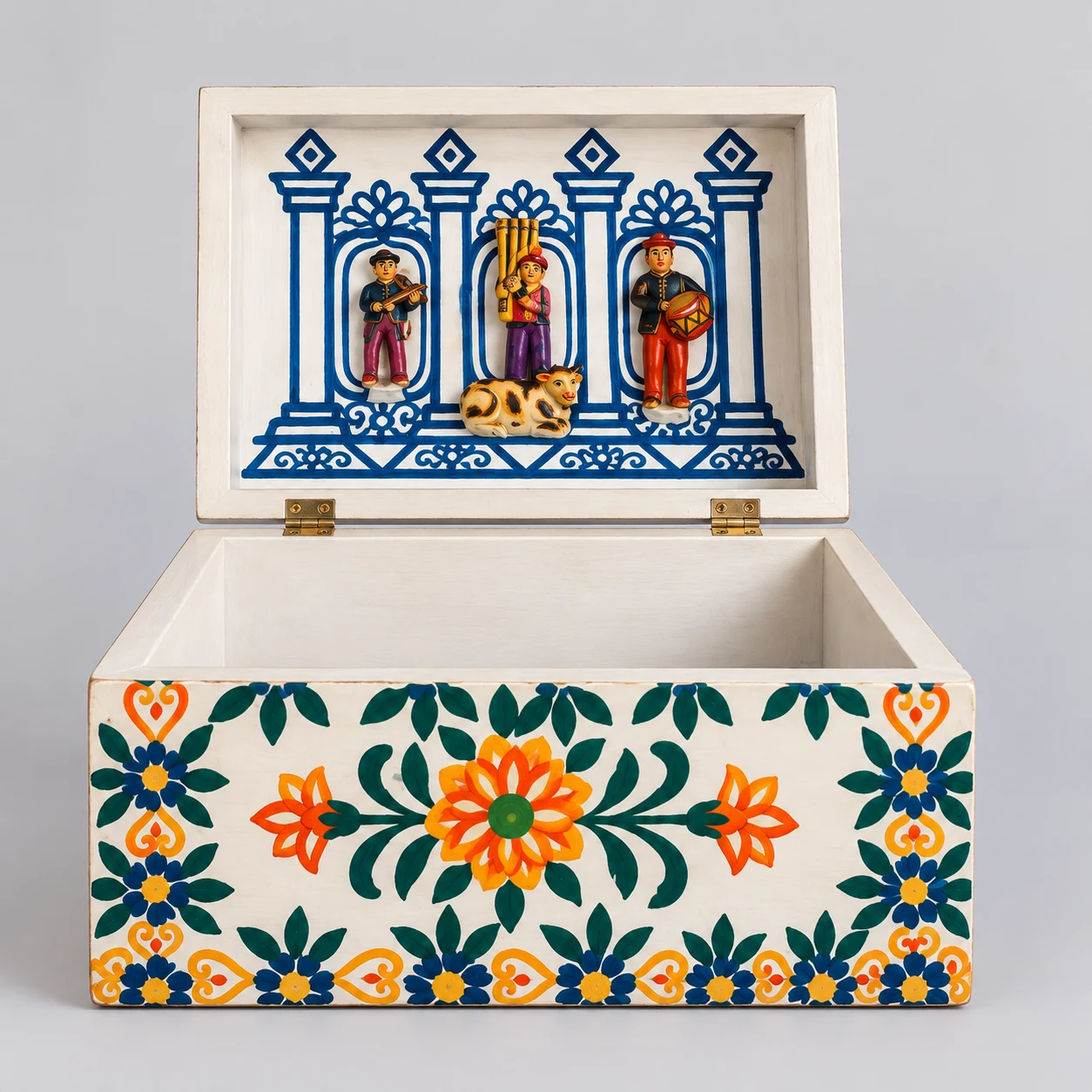
ATELIER DESIGN Historic reference · 70041
Trunk retablo · flowers and figures
Artisan commission · tailored quotation
Imagine this piece in your collection Read its story →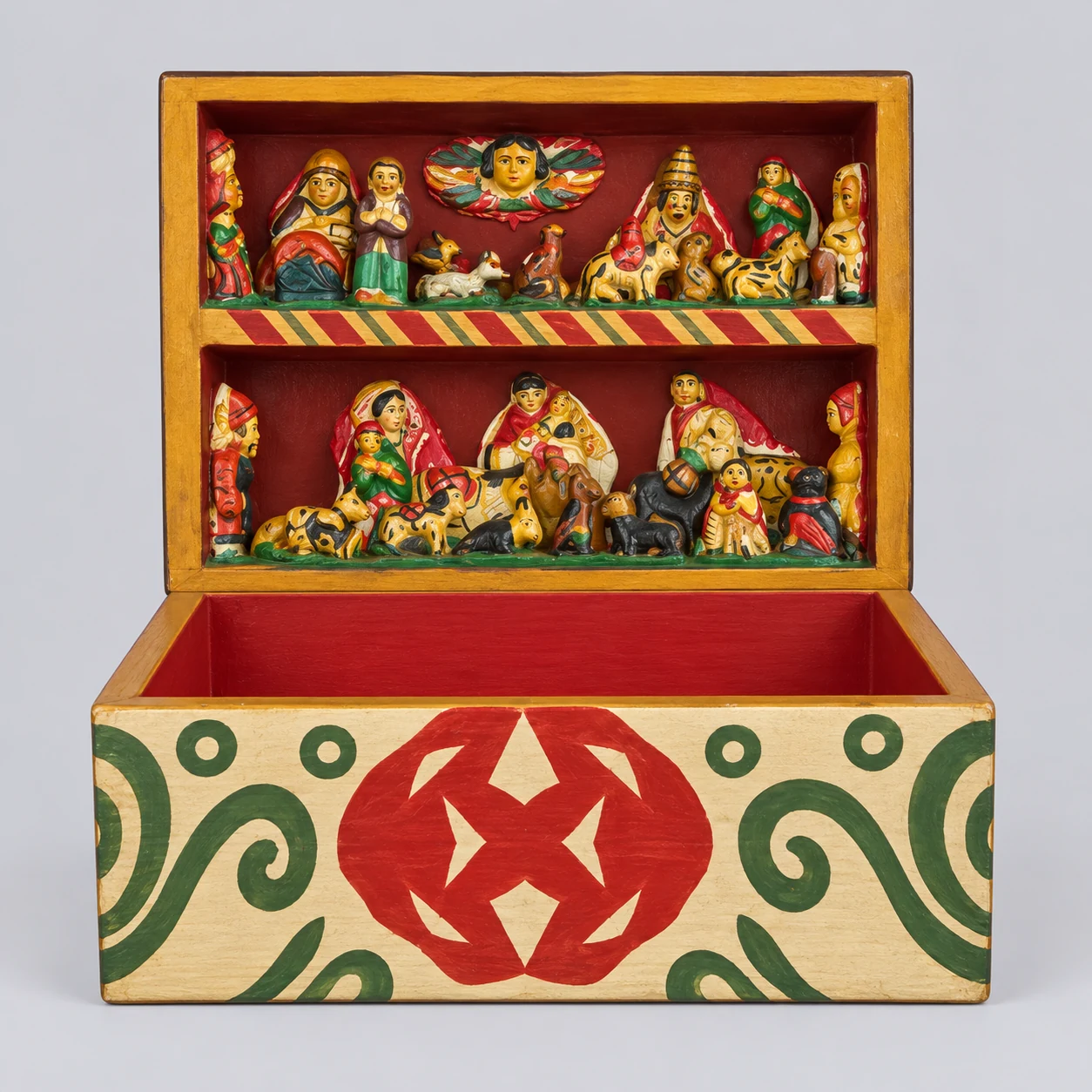 ATELIER DESIGN
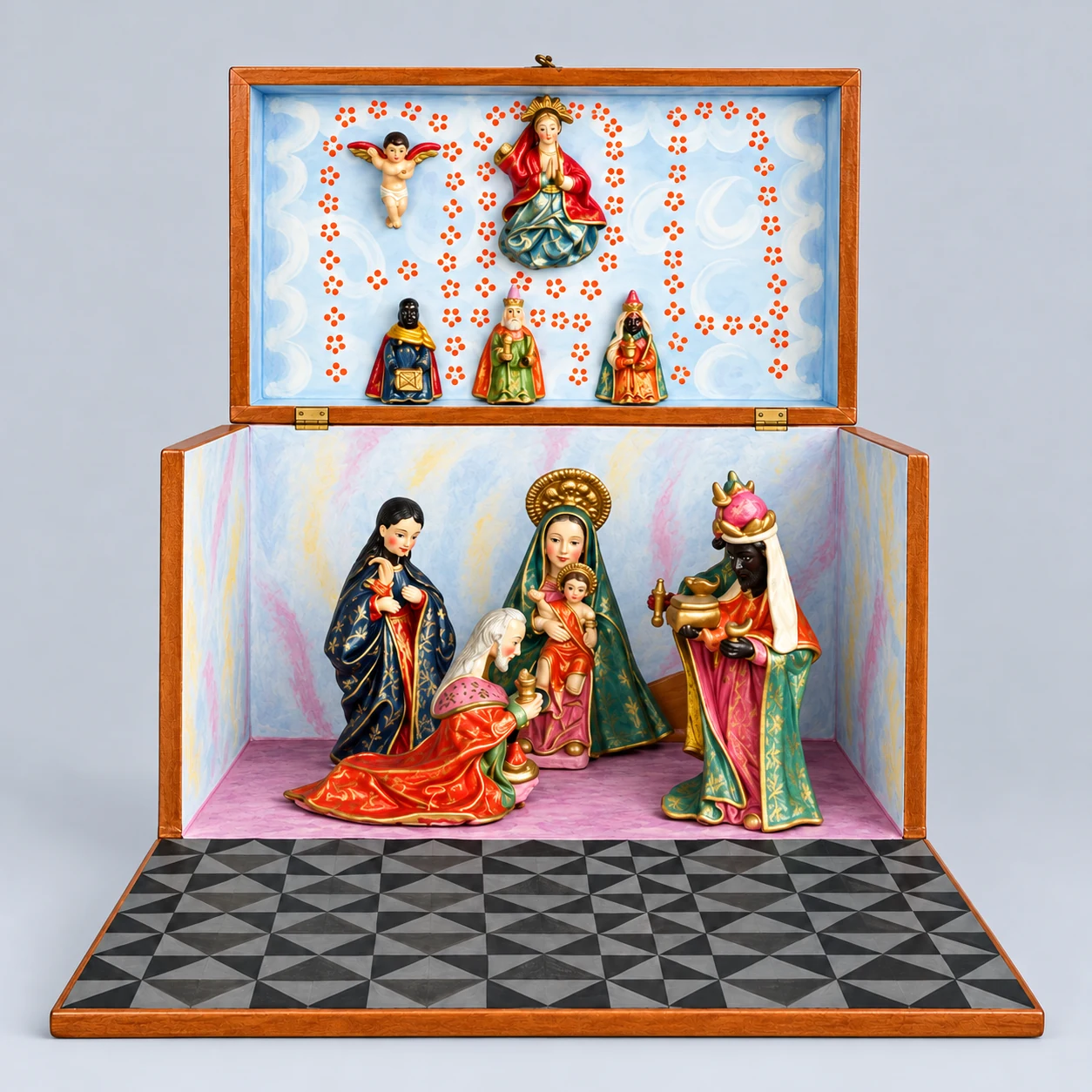
Historic reference · 72574
Trunk retablo · two tiers
Artisan commission · tailored quotation
Imagine this piece in your collection Read its story → ATELIER DESIGN Historic reference · 72575
Trunk retablo · Epiphany
Artisan commission · tailored quotation
Imagine this piece in your collection Read its story →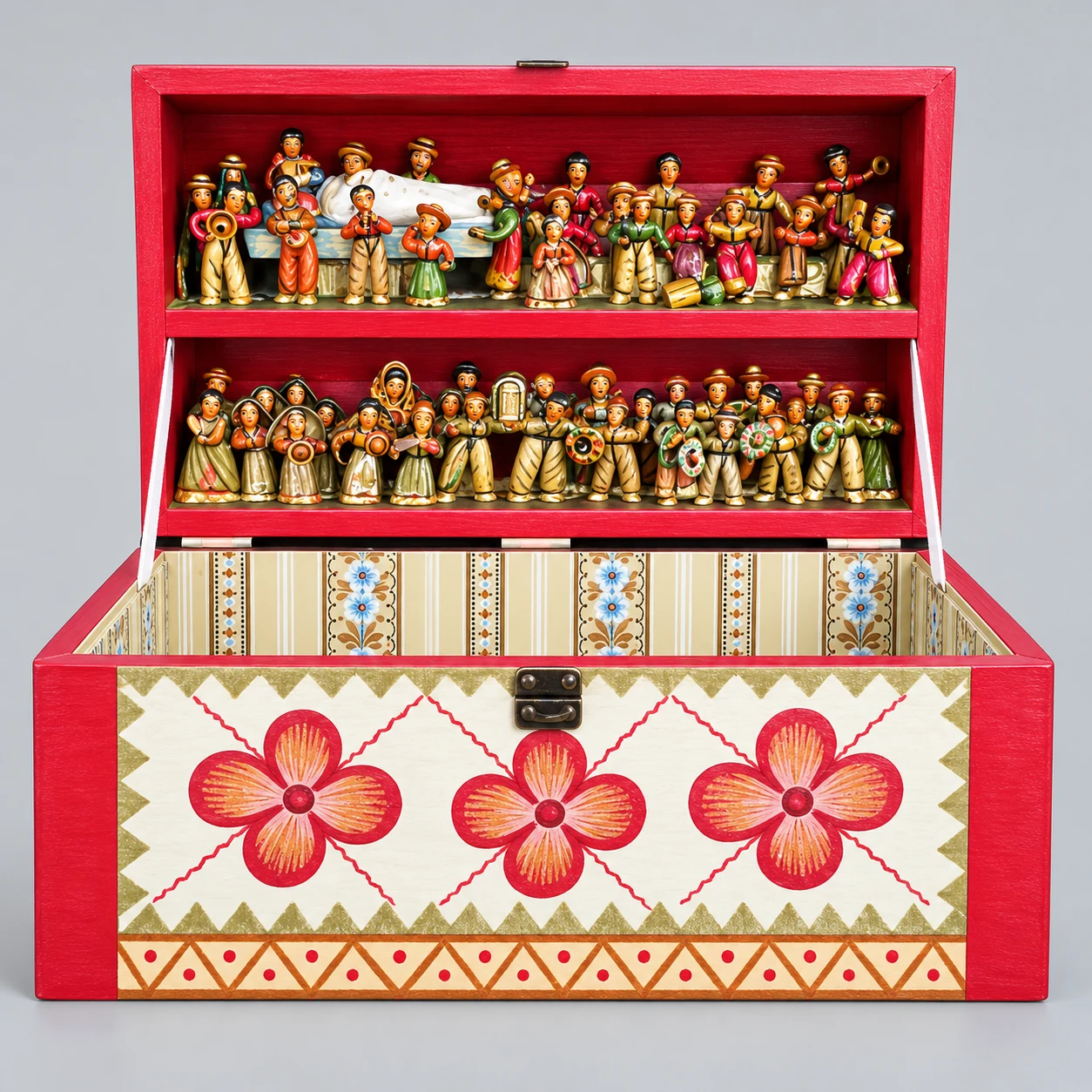 ATELIER DESIGN
Historic reference · 72612
Trunk retablo · The Death of the Poor
Artisan commission · tailored quotation
Imagine this piece in your collection Read its story →Atelier AllpaCraft designs inspired by historical references. Explore the museum records in the sources and commission a new artisan creation.
Explore the research behind the story Historical records, interpretations, methods and unanswered questions
01 / RESEARCH QUESTION
The central question
What can a contemporary commission preserve, and what must it interpret, when its reference is a ritual or museum object?
Interpretive thesis
San Marcos ritual boxes and trunk retablos share forms and skills, but their historical functions are not interchangeable. Study use, construction, circulation and object records separately.
02 / THE RESEARCH
How we traced this story
- Comparative reading of the National Museum of Peruvian Culture's 2008 catalogue, printed pp. 38–41 and 52–55, and the 2019 heritage resolution.
- Consulted National Museum of Peruvian Culture collection records, historical documents and specialist publications. Each object’s recorded characteristics were kept distinct from the interpretations explored by AllpaCraft.
- Contextual museum, heritage and scholarly literature explains forms and historical uses; it does not automatically attribute an individual object to a named maker.
- Separates documented facts about the museum object, what can be seen in the photograph, and proposals requiring validation by a commissioned Atelier master.
- Individual object records are evaluated independently of broad histories of the craft.
03 / CLUES FROM THE SOURCES
What the historical sources reveal
These clues connect documented history with possible meanings. The original records are linked so you can explore the story yourself.
A ritual box, not merely ornament
- What history tells us
- The 2008 museum study and 2019 declaration link San Marcos and San Lucas boxes with livestock protection, fertility and ceremonial settings.
- A possible meaning
- Its historical meaning depends on the social use of the figures, not just the presence of a wooden case.
- A question worth exploring
- A similar-looking box does not prove that its owner used it in livestock marking rites.
Discover the sources: Instituto Nacional de Cultura / Museo Nacional de la Cultura Peruana , Ministerio de Cultura
The trunk retablo combines utility and devotion
- What history tells us
- The museum's study describes devotional scenes within the lid of a functioning chest.
- A possible meaning
- The hinged lid and lower storage body form a distinctive narrative architecture.
- A question worth exploring
- Specific construction details from one published example cannot be applied to every museum record.
Discover the sources: Instituto Nacional de Cultura / Museo Nacional de la Cultura Peruana
New audiences transformed the repertoire
- What history tells us
- Research on Joaquín López Antay explores the emergence of new themes and an urban audience.
- A possible meaning
- Craft continuity also concerns makers, workshops and changed social settings.
- A question worth exploring
- Broad stylistic kinship does not establish authorship of an individual piece.
Discover the sources: Pontificia Universidad Católica del Perú , Instituto de Estudios Peruanos
Recreation requires declared decisions
- What history tells us
- The four selected records specify wood and dimensions but do not fully document figure materials, techniques or makers.
- A possible meaning
- A contemporary craft commission can preserve known forms while documenting what it has had to reinterpret.
- A question worth exploring
- Reference images and unverified details must not be presented as museum-certified replicas.
Discover the sources: Instituto Nacional de Cultura / Museo Nacional de la Cultura Peruana
CRITICAL ICONOGRAPHIC GLOSSARY
Terms for reading the historical objects
These are sourced comparative definitions. No term alone authenticates an object, establishes its maker or guarantees a specific historical use.
- San Marcos / San Lucas devotional chest
-
An Andean devotional wooden chest associated, among other uses, with requests for livestock protection and fertility; the Ministry describes saint figures and pastoral scenes in a documented traditional configuration.
Interpretive limit: A documented traditional format does not establish the particular narrative, function or date of every two-tier trunk-retablo.
Sources: Instituto Nacional de Cultura / Museo Nacional de la Cultura Peruana · Ministerio de Cultura
- Ayacucho retablo
-
A craft tradition from Ayacucho whose knowledge, techniques and iconography were recognized by Peru's Ministry of Culture in 2019, combining figurine modelling, painted compositions and varied subjects.
Interpretive limit: Recognition of a cultural practice does not certify any particular object's maker, exact materials or accession history.
Sources: Ministerio de Cultura
- Imagery-maker chest / portable altarpiece
-
Historiographic terms applied to portable devotional and figurative containers; Labán Salguero documents the importance of separating names and trajectories when studying nineteenth-century objects.
Interpretive limit: These comparative terms do not establish a direct chronology, maker or functional continuity for the twentieth-century MNCP trunk-retablos.
Sources: Instituto Nacional de Cultura / Museo Nacional de la Cultura Peruana
- Trunk-retablo
-
A descriptive museum category for trunk-shaped objects with a figural programme; the confirmed dimensions, materials and identification belong to each individual inventory record.
Interpretive limit: Chest shape alone does not prove practical storage, ritual use or a particular mechanism for the specific object.
Sources: Instituto Nacional de Cultura / Museo Nacional de la Cultura Peruana
- Compositional tiers or registers
-
Spatial levels organizing figurines and scenes within a box; the 2019 declaration describes one traditional plan while other documented works use different groupings.
Interpretive limit: The number of tiers alone does not identify saints, pastoral subjects or the reading order of an individual work.
Sources: Ministerio de Cultura
- Floral ornament
-
Painted roses and vegetal designs documented on doors and surfaces of certain traditional chests and also visible on objects held in other collections.
Interpretive limit: Similar flowers do not establish the religious meaning, author or pigments of any particular museum inventory.
Sources: Ministerio de Cultura
- Modelled figurines and pastes
-
The ministerial declaration describes sculpted figures made from mixtures that vary across workshops and periods; this is a general technique account, not a laboratory analysis of these objects.
Interpretive limit: Neither an overview photograph nor a chest's total recorded mass establishes a figurine's recipe, wood species or adhesive.
Sources: Ministerio de Cultura
- Polychromy
-
Use of painted colour on the chest and its figures, a feature of a tradition combining carving, modelling and pictorial work; visual description differs from chemical pigment identification.
Interpretive limit: Colour differences between archival images cannot establish an individual object's original pigments, binders or production methods.
Sources: Instituto Nacional de Cultura / Museo Nacional de la Cultura Peruana · Ministerio de Cultura
- Workshop lineage and transmission
-
Documented relationships of apprenticeship, family practice and changing audiences; Joaquín López Antay's career is a well-described part of this broader historical context.
Interpretive limit: Artistic lineage does not establish that López Antay, Jesús Urbano Rojas or any other workshop member made a specific MNCP object.
Sources: Ministerio de Cultura · Pontificia Universidad Católica del Perú
- Epiphany and Nativity
-
Related subjects of the Christian narrative represented in figurative boxes; Epiphany is the catalogue title applied to historic museum item 72575.
Interpretive limit: Related religious subjects do not establish that differently numbered works are identical or share dates, figures or materials.
Sources: Ministerio de Cultura
- National registration and museum accession
-
Documentary identifiers that distinguish individual objects; national registration, MNCP accession and a public web-record number may serve different administrative roles.
Interpretive limit: Identical titles or broadly similar scenes do not establish a crosswalk between different registration numbers without documentary evidence.
Sources: Instituto Nacional de Cultura / Museo Nacional de la Cultura Peruana
- Costumbrista scenes and social memory
-
Narratives of communal celebrations, activities and social experience that expanded within twentieth-century Ayacucho retablo practice; these provide comparative context for a scene titled 'The Death of the Poor'.
Interpretive limit: A reading of mourning or inequality is interpretive and does not establish the creator or their individual political intention for inventory 72612.
Sources: Instituto Nacional de Cultura / Museo Nacional de la Cultura Peruana · Ministerio de Cultura
04 / CRITICAL DISCUSSION
Interpretation and implications
Connected histories, distinct functions
Portable saint shrines, San Marcos boxes and devotional chests all organize images in enclosed spaces. But the livestock-protection function of a ceremonial box differs from that of a chest containing a retablo in its lid.
South Andean comparative scholarship emphasizes movement, community memory and changing uses instead of a single universal origin.
Material evidence and the craft workshop
Historical publications discuss wood and mixtures of gypsum, potato and pigments in particular periods. The four individual museum records, however, only establish wood as their listed material; they do not settle every miniature's composition.
A workshop brief must identify visible structure and unresolved details before fixing a material recipe or claiming exact fidelity.
Atelier as an intermediary between reference and maker
The 2019 declaration recognises knowledge, techniques and iconography sustained by bearers of the tradition; it does not certify individual commercial products.
Atelier AllpaCraft's role is to connect a documented object with selected masters. A finished commission should credit its actual maker and carry truthful production records.
Four references, four investigations
Records 70041, 72574, 72575 and 72612 all refer to wooden trunk retablos in the National Museum of Peruvian Culture, but differ in size, represented scene and recorded date.
They are offered as starting points for a commissioned contemporary recreation, not as antiquities available for purchase.
05 / QUESTIONS THAT REMAIN
The questions that keep this history alive
- This is documentary research without direct object examination or maker interviews.
- Image reuse rights for institutional photography have not been cleared.
- Reference images require specialist review and are not evidence of a completed object.
06 / OPEN QUESTIONS
Next lines of inquiry
- Which master will independently validate the structural and iconographic decisions?
- Can licensed detail images be secured from the collection?
- How can production materials and museum-reference materials be documented separately?
07 / READ FURTHER
Books, archives and museum records
Museum catalogue records and contextual scholarship checked for this editorial dossier on October 22, 2026. Only object-specific records establish object metadata; broader sources do not authenticate an individual piece.
- Instituto Nacional de Cultura / Museo Nacional de la Cultura Peruana. Obras maestras en las colecciones del Museo Nacional de la Cultura Peruana, 2008, pp. 38–41 y 52–55. Consult source ↗ . Source consulted · 2026-10-22
- Ministerio de Cultura. Conocimientos, técnicas e iconografía del retablo ayacuchano, RVM 098-2019. Consult source ↗ . Source consulted · 2026-10-22
- Instituto de Estudios Peruanos. El retablo ayacuchano: un arte de los Andes (1992). Consult source ↗ . Source consulted · 2026-10-22
- Revista Chungará / María Carolina Odone. Las cajas de santos y su relación con los circuitos de la memoria (2019). Consult source ↗ . Source consulted · 2026-10-22
- Pontificia Universidad Católica del Perú. Crear y validar a un artista: Joaquín López Antay, su obra y el Estado (1940–1977). Consult source ↗ . Source consulted · 2026-10-22