A STORY THAT INVITES QUESTIONS
The Death of the Poor: a retablo of human memory
Popular art can portray festivals, work and devotion, but also bring difficult subjects into view. The Death of the Poor invites us to consider how a miniature scene may open a conversation about loss, dignity and community.
When a small scene raises large questions
The museum’s recorded title is striking: Trunk-retablo with the Death of the Poor. It points toward a subject different from a festival or a livestock scene. Yet it does not dictate a single reading: mourning, communal memory or social commentary are possibilities that call for careful study of the figures.
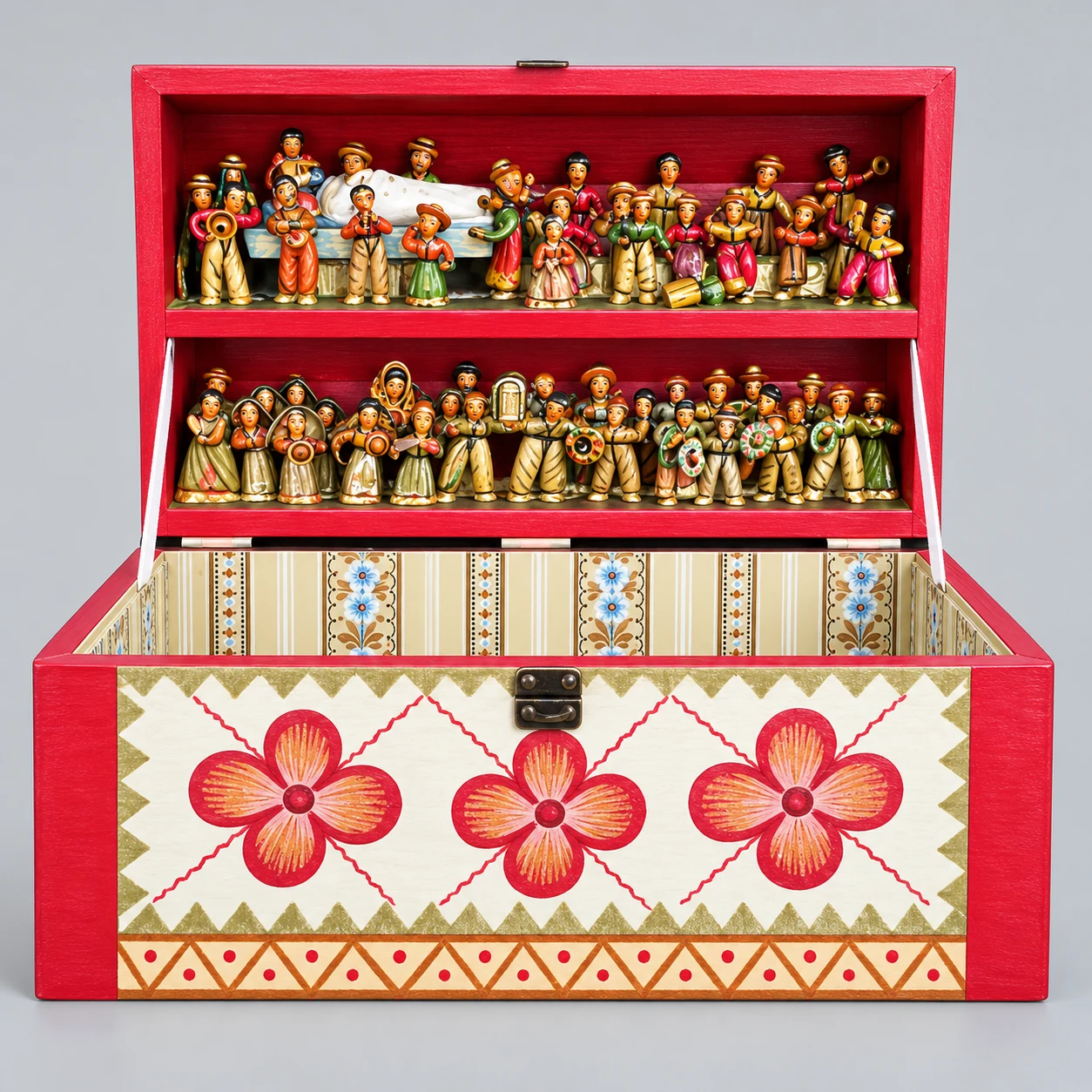
Twentieth-century Ayacucho retablistas broadened their subjects. Everyday and costumbrista narratives offer a historical context for considering why a chest might explore such a complex human experience. This object’s precise meaning remains an intriguing question.
Explore the historical sources: Ministerio de Cultura / Museo Nacional de la Cultura Peruana · Ministerio de Cultura del Perú
A name in craft history, an authorship still to discover
Jesús Urbano Rojas belongs to the documented story of apprenticeship and change in Ayacucho retablos. His career, described by the Ministry of Culture, and comparisons discussed by Magaly Patricia Labán Salguero offer fertile ground for studying how themes such as the Death of the Poor circulated.
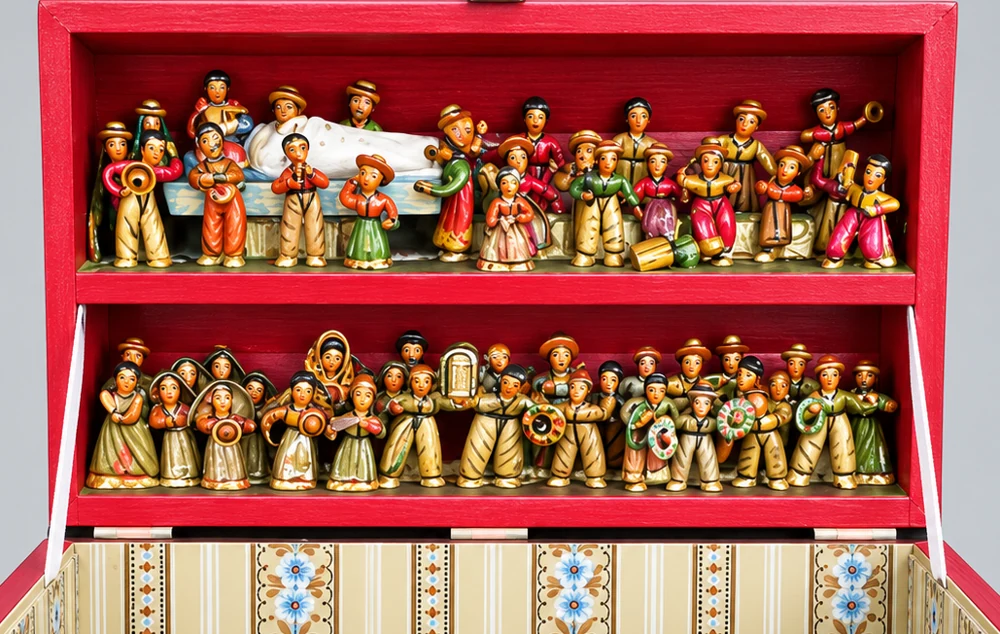
Another detail makes the case especially intriguing: a 2020 ministerial document and the museum’s individual record use different registration numbers for works of similar title. Whether they refer to the same piece remains unknown. This does not lessen the inquiry; it shows how much history still lies between workshops, archives and visual memory. A new commission can honour the subject without claiming an unconfirmed maker for the original.
Explore the historical sources: Ministerio de Cultura del Perú · Universidad Nacional Mayor de San Marcos · Ministerio de Cultura / Museo Nacional de la Cultura Peruana · Ministerio de Cultura
THE ATELIER COLLECTION
From the story to your own commission
Discover designs inspired by the heritage of Ayacucho. Each proposal opens the door to a new handcrafted piece made especially for your collection.
ATELIER DESIGN Historic reference · 72612
Trunk retablo · The Death of the Poor
Artisan commission · tailored quotation
Imagine this piece in your collectionAtelier AllpaCraft designs inspired by historical references. Explore the museum records in the sources and commission a new artisan creation.
ATELIER DESIGNS · COMMISSIONED WORK
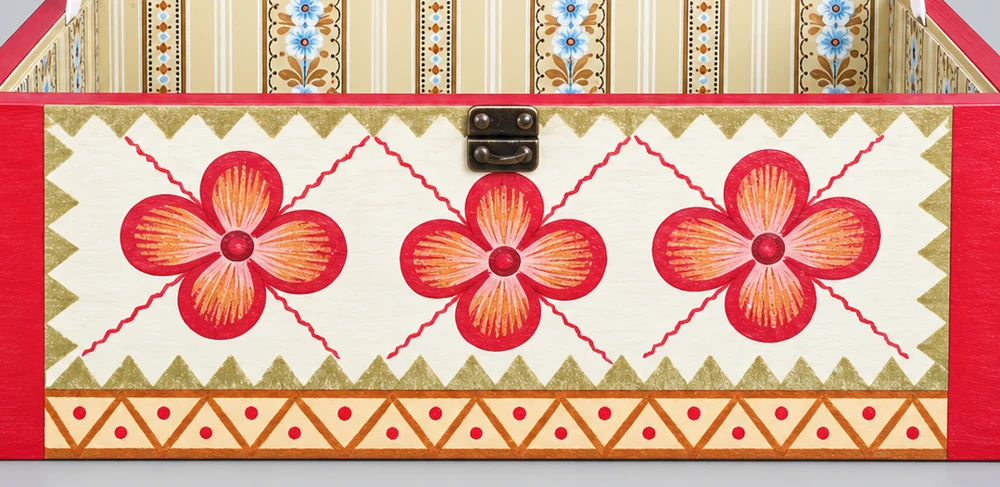
A closer look at this Atelier design, conceived as inspiration for a new handcrafted commission.
Explore the research behind the story Historical records, interpretations, methods and unanswered questions
VISUAL EVIDENCE REVIEW
What reference images show — and what remains uncertain
Compared with one archival museum overview, not a physical examination. A reference image does not document completed handmade work; iconography and construction require specialist review.
- Museum overview
- The archival view shows densely populated upper and lower tiers, with large flowers painted on the frontal chest.
- Broad structure retained
- The reference image retains the two-tier structure and a front with three prominent floral motifs.
- Differences / uncertainty
- The reference image simplifies and brightens figures and flowers; individual characters, gestures and mourning episodes are not authenticated.
Decisions requiring a specialist master
- Build an evidence-led inventory of figures within each tier, marking any unresolved characters explicitly.
- Keep the official record 0000089963 separate from the ministry appendix identifier 0000129843 pending concordance; do not assume Jesús Urbano Rojas as maker.
- Do not apply 1958 or 1967 as established dates for this object or the new commission without museum evidence.
Measured colour saturation differs between source images, but cannot establish the original paint colour or the accuracy of a future handmade recreation.
View historical photographs in the official Ministry collection record ↗ · Museum photograph reuse rights remain unverified.
01 / RESEARCH QUESTION
The central question
How can a social-narrative retablo be investigated when official records appear to overlap?
Interpretive thesis
The identity of record 72612 must be kept distinct from the 2020 inventory reference and scholarly discussions of Jesús Urbano until verified cross-references exist.
02 / THE RESEARCH
How we traced this story
- Consulted National Museum of Peruvian Culture collection records, historical documents and specialist publications. Each object’s recorded characteristics were kept distinct from the interpretations explored by AllpaCraft.
- Contextual museum, heritage and scholarly literature explains forms and historical uses; it does not automatically attribute an individual object to a named maker.
- Separates documented facts about the museum object, what can be seen in the photograph, and proposals requiring validation by a commissioned Atelier master.
03 / CLUES FROM THE SOURCES
What the historical sources reveal
These clues connect documented history with possible meanings. The original records are linked so you can explore the story yourself.
The established catalogue identity
- What history tells us
- Record 72612 supplies MNCP-000000012114, national registration 0000089963, wood, twentieth century and 23 × 38 × 22 cm.
- A possible meaning
- These remain the object's defensible primary metadata.
- A question worth exploring
- Neither maker nor exact year appears in this record.
Discover the sources: Ministerio de Cultura / Museo Nacional de la Cultura Peruana
A second inscription with a similar image
- What history tells us
- The 2020 ministerial appendix includes the same title under 0000129843, with a visibly similar image.
- A possible meaning
- This may signal connected records or a change in cataloguing.
- A question worth exploring
- Similarity cannot settle whether these denote the same object, a copy or another association.
Discover the sources: Ministerio de Cultura , Ministerio de Cultura / Museo Nacional de la Cultura Peruana
An academic attribution lead
- What history tells us
- University research discusses a 1958 work with this title in relation to Jesús Urbano.
- A possible meaning
- The literature gives the research team a concrete lead to check.
- A question worth exploring
- It is not yet an authenticated maker/date attribution for record MNCP-000000012114.
Discover the sources: Universidad Nacional Mayor de San Marcos
A densely figured chest
- What history tells us
- The known image shows two tiers filled with miniatures and a floral front.
- A possible meaning
- The contrast between a public painted face and a crowded narrative interior invites close reading.
- A question worth exploring
- Unreadable small figures must not be given invented identities.
Discover the sources: Ministerio de Cultura / Museo Nacional de la Cultura Peruana
DOCUMENTARY SOURCE TRIANGULATION
Stories and clues from the archives
Museum records preserve names, dimensions and dates; research opens further ways to understand the figures and stories. Each clue is linked to a source, with possible interpretations clearly identified.
FROM THE ARCHIVES
Record 72612 names the object 'Baúl-retablo con la muerte del pobre' and lists 0000089963 / MNCP-000000012114, wood, 23 × 38 × 22 cm and a broad twentieth-century period.
Explore the interpretation and its open questions
What we can discover so far
This record does not conclusively establish Jesús Urbano Rojas as the object's maker or assign its creation to 1958 or 1967.
- Ministerio de Cultura / Museo Nacional de la Cultura Peruana — individual object record
A STORY STILL UNFOLDING
Entry 7 of Resolution 206-2020's appendix lists a similarly titled trunk under registration 0000129843, while catalogue record 72612 lists 0000089963. A concordance between these numbers has NOT been established.
Explore the interpretation and its open questions
What we can discover so far
Shared title and broadly similar photographs cannot establish administrative identity; that appendix does not give a crosswalk to record 0000089963.
Another way to read the scene
These could be separate works, a register revision, a later version or a cataloguing discrepancy; none is proved.
A question for further research
Keep both records separate, compare distinctive observable features and do not transfer any date or authorship from one to the other.
- Ministerio de Cultura / Museo Nacional de la Cultura Peruana — individual object record
- Ministerio de Cultura — documentary comparison
ONE POSSIBLE READING
Magaly P. Labán Salguero's 2016 thesis (pp. 158–159) connects a trunk titled 'La muerte del pobre' to work associated with Jesús Urbano Rojas and discusses 1958 and 1967. This invites an authorship inquiry, not an attribution of inventory item 72612.
Explore the interpretation and its open questions
What we can discover so far
The thesis compares images and retrospective documentation; it does not independently establish the museum register concordance for 0000089963. The reported mark '58/69' remains an undecoded notation.
Another way to read the scene
It may concern another version of the subject, a different workshop or a bibliographic date referring to exhibition/cataloguing rather than manufacture.
A question for further research
Keep Jesús Urbano Rojas and 1958/1967 explicitly hypothetical rather than inserting them as established maker and date in product metadata.
- Ministerio de Cultura / Museo Nacional de la Cultura Peruana — individual object record
- Universidad Nacional Mayor de San Marcos — documentary comparison
- Universidad Nacional Mayor de San Marcos — typological context
ONE POSSIBLE READING
The title and figures arranged over two tiers invite a possible reading of mourning, inequality or social memory; this is narrative interpretation, not identification of each documented character.
Explore the interpretation and its open questions
What we can discover so far
Neither the title alone nor figures visible in an overview determines individual roles, gestures or the maker's personal intentions.
Another way to read the scene
The scene might draw on religious, theatrical or costumbrista traditions without depicting a specific recorded historical event.
A question for further research
Keep unreadable figures unnamed and compare narrative motifs with reliably documented works and scholarship.
- Ministerio de Cultura / Museo Nacional de la Cultura Peruana — individual object record
- Ministerio de Cultura del Perú — typological context
- Universidad Nacional Mayor de San Marcos — documentary comparison
REGIONAL ICONOGRAPHY AND WORKSHOP HISTORY
The craft, its artists and the stories they shared
Other collections and research help us trace how Ayacucho artisans transformed familiar forms into new narratives. We compare ideas and techniques while respecting the individual history of each museum object.
WORKSHOP HISTORY
A documented artistic lineage does not authenticate a similar object
Peru's Ministry of Culture documents Jesús Urbano Rojas's apprenticeship with Joaquín López Antay and his later costumbrista works. Labán Salguero's 2016 thesis compares a work called 'La muerte del pobre' with his production.
- Research hypothesis
- Together these references justify investigating narrative affinities and potential workshop lineage for the subject, while the identity of catalogue object 72612 remains open.
- Viable alternative
- A similarly titled version may have circulated between workshops, been made by another artist or referred to a different work from the one discussed in the thesis.
- What still invites research
- The master's biography and the scholarly comparison do not establish his authorship of 0000089963 or a concordance with registration 0000129843. The object attribution remains unconfirmed.
References: Ministerio de Cultura / Museo Nacional de la Cultura Peruana · Ministerio de Cultura del Perú · Universidad Nacional Mayor de San Marcos
ICONOGRAPHIC COMPARISON
'The Death of the Poor' across narrative, custom and social interpretation
The heritage declaration records the expansion of retablo subjects, while PUCP scholarship examines twentieth-century changes in audiences and art markets. Research literature discusses 'La muerte del pobre' as a subject for comparative study.
- Research hypothesis
- Its title and narrative arrangement invite a possible reading of inequality, mourning or communal life, without assigning definite names or intentions to individual figures.
- Viable alternative
- The work may employ religious, theatrical, memorial or inherited narrative conventions without expressing a direct social critique.
- What still invites research
- It has not been established that 72612 is the same object reproduced in comparative publications. Neither a death-related title nor a general formal resemblance establishes the maker's political intent or identity.
References: Ministerio de Cultura / Museo Nacional de la Cultura Peruana · Ministerio de Cultura del Perú · Pontificia Universidad Católica del Perú · Universidad Nacional Mayor de San Marcos
CRITICAL ICONOGRAPHIC GLOSSARY
Terms for reading the historical objects
These are sourced comparative definitions. No term alone authenticates an object, establishes its maker or guarantees a specific historical use.
- San Marcos / San Lucas devotional chest
-
An Andean devotional wooden chest associated, among other uses, with requests for livestock protection and fertility; the Ministry describes saint figures and pastoral scenes in a documented traditional configuration.
Interpretive limit: A documented traditional format does not establish the particular narrative, function or date of every two-tier trunk-retablo.
Sources: Instituto Nacional de Cultura / Museo Nacional de la Cultura Peruana · Ministerio de Cultura del Perú
- Ayacucho retablo
-
A craft tradition from Ayacucho whose knowledge, techniques and iconography were recognized by Peru's Ministry of Culture in 2019, combining figurine modelling, painted compositions and varied subjects.
Interpretive limit: Recognition of a cultural practice does not certify any particular object's maker, exact materials or accession history.
Sources: Ministerio de Cultura del Perú
- Imagery-maker chest / portable altarpiece
-
Historiographic terms applied to portable devotional and figurative containers; Labán Salguero documents the importance of separating names and trajectories when studying nineteenth-century objects.
Interpretive limit: These comparative terms do not establish a direct chronology, maker or functional continuity for the twentieth-century MNCP trunk-retablos.
Sources: Instituto Nacional de Cultura / Museo Nacional de la Cultura Peruana · Universidad Nacional Mayor de San Marcos
- Trunk-retablo
-
A descriptive museum category for trunk-shaped objects with a figural programme; the confirmed dimensions, materials and identification belong to each individual inventory record.
Interpretive limit: Chest shape alone does not prove practical storage, ritual use or a particular mechanism for the specific object.
Sources: Ministerio de Cultura / Museo Nacional de la Cultura Peruana · Instituto Nacional de Cultura / Museo Nacional de la Cultura Peruana
- Compositional tiers or registers
-
Spatial levels organizing figurines and scenes within a box; the 2019 declaration describes one traditional plan while other documented works use different groupings.
Interpretive limit: The number of tiers alone does not identify saints, pastoral subjects or the reading order of an individual work.
Sources: Ministerio de Cultura del Perú
- Floral ornament
-
Painted roses and vegetal designs documented on doors and surfaces of certain traditional chests and also visible on objects held in other collections.
Interpretive limit: Similar flowers do not establish the religious meaning, author or pigments of any particular museum inventory.
Sources: Ministerio de Cultura del Perú
- Modelled figurines and pastes
-
The ministerial declaration describes sculpted figures made from mixtures that vary across workshops and periods; this is a general technique account, not a laboratory analysis of these objects.
Interpretive limit: Neither an overview photograph nor a chest's total recorded mass establishes a figurine's recipe, wood species or adhesive.
Sources: Ministerio de Cultura del Perú
- Polychromy
-
Use of painted colour on the chest and its figures, a feature of a tradition combining carving, modelling and pictorial work; visual description differs from chemical pigment identification.
Interpretive limit: Colour differences between archival images cannot establish an individual object's original pigments, binders or production methods.
Sources: Instituto Nacional de Cultura / Museo Nacional de la Cultura Peruana · Ministerio de Cultura del Perú
- Workshop lineage and transmission
-
Documented relationships of apprenticeship, family practice and changing audiences; Joaquín López Antay's career is a well-described part of this broader historical context.
Interpretive limit: Artistic lineage does not establish that López Antay, Jesús Urbano Rojas or any other workshop member made a specific MNCP object.
Sources: Ministerio de Cultura del Perú · Ministerio de Cultura del Perú · Pontificia Universidad Católica del Perú
- National registration and museum accession
-
Documentary identifiers that distinguish individual objects; national registration, MNCP accession and a public web-record number may serve different administrative roles.
Interpretive limit: Identical titles or broadly similar scenes do not establish a crosswalk between different registration numbers without documentary evidence.
Sources: Ministerio de Cultura / Museo Nacional de la Cultura Peruana · Instituto Nacional de Cultura / Museo Nacional de la Cultura Peruana · Ministerio de Cultura
- Costumbrista scenes and social memory
-
Narratives of communal celebrations, activities and social experience that expanded within twentieth-century Ayacucho retablo practice; these provide comparative context for a scene titled 'The Death of the Poor'.
Interpretive limit: A reading of mourning or inequality is interpretive and does not establish the creator or their individual political intention for inventory 72612.
Sources: Instituto Nacional de Cultura / Museo Nacional de la Cultura Peruana · Ministerio de Cultura del Perú · Ministerio de Cultura del Perú
OPEN RESEARCH HYPOTHESES
Plausible interpretations awaiting verification
Each proposal separates supporting evidence, a viable alternative and a check that could refute it. Evidence support is NOT a probability, museum authentication or approved object-level metadata.
HYPOTHESIS · converging evidence
Registration 0000089963 and 0000129843 may identify the same chest
Matching title and a strongly similar image in record 72612 (0000089963) and the 2020 appendix (0000129843) support, but do not prove, shared object identity or linked registration.
- Evidence
- Museum object sheet MNCP-000000012114 and RVM 206-2020 appendix, entry 7, PDF page 2; both depict similarly organized miniature tiers and floral decoration.
- Alternative explanation
- The entries might reflect linked inventories, a second work, a reproduction, or a cataloguing error; no official identifier concordance has been obtained.
- How to test it
- Request both record histories, high-resolution masters, dates of registration and mapping of former identifiers; compare distinctive material details.
Supporting references: mincul-72612 , mincul-2020-anexo
HYPOTHESIS · contextual support
An attribution to Jesús Urbano Rojas warrants testing
Labán Salguero analyses a work titled The Death of the Poor in relation to Jesús Urbano Rojas, with dimensions close to record 72612; this is a serious lead rather than verified authorship of this catalogue record.
- Evidence
- The 2016 UNMSM thesis gives 23.7 × 38.1 × 22.3 cm; the current object file lists 23 × 38 × 22 cm but does not name an artist.
- Alternative explanation
- Multiple workshop versions may share the title, or the thesis may depict a similar object with a different collection identity.
- How to test it
- Compare the thesis' 58/69 reverse marking with museum object photographs and acquisition history; seek formal authorship confirmation.
Supporting references: mincul-72612 , unmsm-urbano
HYPOTHESIS · exploratory reading
1958 and 1967 may derive from differing historical datings
The UNMSM thesis dates a similarly titled chest to 1958 and notes an earlier retrospective assigning 1967; record 72612 itself only says twentieth century, so no individual year is yet confirmed.
- Evidence
- Labán Salguero discusses 1958, a 58/69 notation and a 1967 retrospective catalogue, while the present MNCP record provides no exact year.
- Alternative explanation
- Either year could indicate production, acquisition, publication, another version or a transcription mistake; the notation 58/69 has not been officially decoded.
- How to test it
- Compare contemporary records, object markings and the cited retrospective catalogue; request the museum's authoritative dating before amending public metadata.
Supporting references: mincul-72612 , unmsm-urbano
04 / CRITICAL DISCUSSION
Interpretation and implications
A title that raises social questions
The title expressly invokes poverty and death. As a motif in Ayacucho narrative craft, it calls for careful social and artistic context, not an exoticising decorative description.
Any interpretation of specific mourners, events or historical episodes needs more evidence than the current general photograph.
Two inventory identifiers
The accessible record provides 0000089963, whereas the 2020 appendix prints 0000129843 with a very similar image. It would be premature either to combine or definitively separate these records.
A museum enquiry should request historical inventory mappings, photographs and acquisition records.
The Jesús Urbano research lead
Published university work discusses a 1958 chest with this title in relation to Jesús Urbano, noting variation between catalogues. This is an important hypothesis, not a settled attribution for this specific identifier.
Editorial credit must remain «author not established in consulted collection record» pending verification.
Making a new work from a complex subject
A specialist master should discuss each legible scene and document solutions for uncertain details. Reference images must remain distinct from museum originals and future handmade objects.
05 / QUESTIONS THAT REMAIN
The questions that keep this history alive
- No institutional reply resolving the two identifiers.
- Comparison made from overview and appendix thumbnails, not certified master files.
- Jesús Urbano/1958 remains a research lead for this specific record.
- Commercial photo reuse has not been cleared.
06 / OPEN QUESTIONS
Next lines of inquiry
- Are the two registration numbers linked by the museum?
- What source identifies the maker and year of this particular piece?
- Can detailed photographs clarify the narrative?
07 / READ FURTHER
Books, archives and museum records
Museum catalogue records and contextual scholarship checked for this editorial dossier on October 22, 2026. Only object-specific records establish object metadata; broader sources do not authenticate an individual piece.
- Ministerio de Cultura / Museo Nacional de la Cultura Peruana. Ficha de catálogo MNCP-000000012114, registro nacional 0000089963; PDF de colección. Consult source ↗ . Source consulted · 2026-10-22
- Ministerio de Cultura. Ficha oficial PDF MNCP-000000012114. Consult source ↗ . Source consulted · 2026-10-22
- Instituto Nacional de Cultura / Museo Nacional de la Cultura Peruana. Obras maestras en las colecciones del Museo Nacional de la Cultura Peruana, 2008, pp. 38–41 y 52–55. Consult source ↗ . Source consulted · 2026-10-22
- Ministerio de Cultura. RVM 206-2020-VMPCIC-MC, anexo de bienes, n.º 7. Consult source ↗ . Source consulted · 2026-10-22
- Universidad Nacional Mayor de San Marcos. Magaly Patricia Labán Salguero (2016), Tradición y recreación en el retablo ayacuchano de la familia Jiménez (1980–2000), pp. 158–159. Consult source ↗ . Source consulted · 2026-10-22
- Ministerio de Cultura del Perú. RVM 098-2019-VMPCIC-MC y nota institucional de 13 de junio de 2019 sobre el retablo ayacuchano. Consult source ↗ . Source consulted · 2026-10-22
- Universidad Nacional Mayor de San Marcos. Labán Salguero (2020), Reflexiones en torno al estudio de los retablos portátiles peruanos y las cajas de imaginero del siglo XIX, Tesis 13(16):155–168. Consult source ↗ . Source consulted · 2026-10-22
- Ministerio de Cultura del Perú. Descanse en paz, maestro Jesús Urbano Rojas (21 mayo 2014): trayectoria, aprendizaje y obra costumbrista. Consult source ↗ . Source consulted · 2026-10-22
- Pontificia Universidad Católica del Perú. Diego Alonso Ortiz Ortigas (2024), Crear y validar a un artista: Joaquín López Antay, su obra y el Estado (1940–1977). Consult source ↗ . Source consulted · 2026-10-22